
In every industry, competition is inevitable. Yet while some businesses continue to grow and thrive, others struggle to maintain market share or eventually disappear altogether. What separates the winners from the rest?
The answer often goes beyond having a great product or service. Successful businesses understand the competitive forces shaping their industry and make strategic decisions accordingly. One of the most widely used frameworks for analysing competition is Porter’s Five Forces, developed by Harvard Business School professor Michael Porter.
Whether you run a local café, an e-commerce store, a consultancy, or a technology startup in Singapore, understanding these five forces can help you identify risks, uncover opportunities, and build a stronger competitive position.
What is Porter’s Five Forces?
Porter’s Five Forces is a framework used to assess the level of competition within an industry.

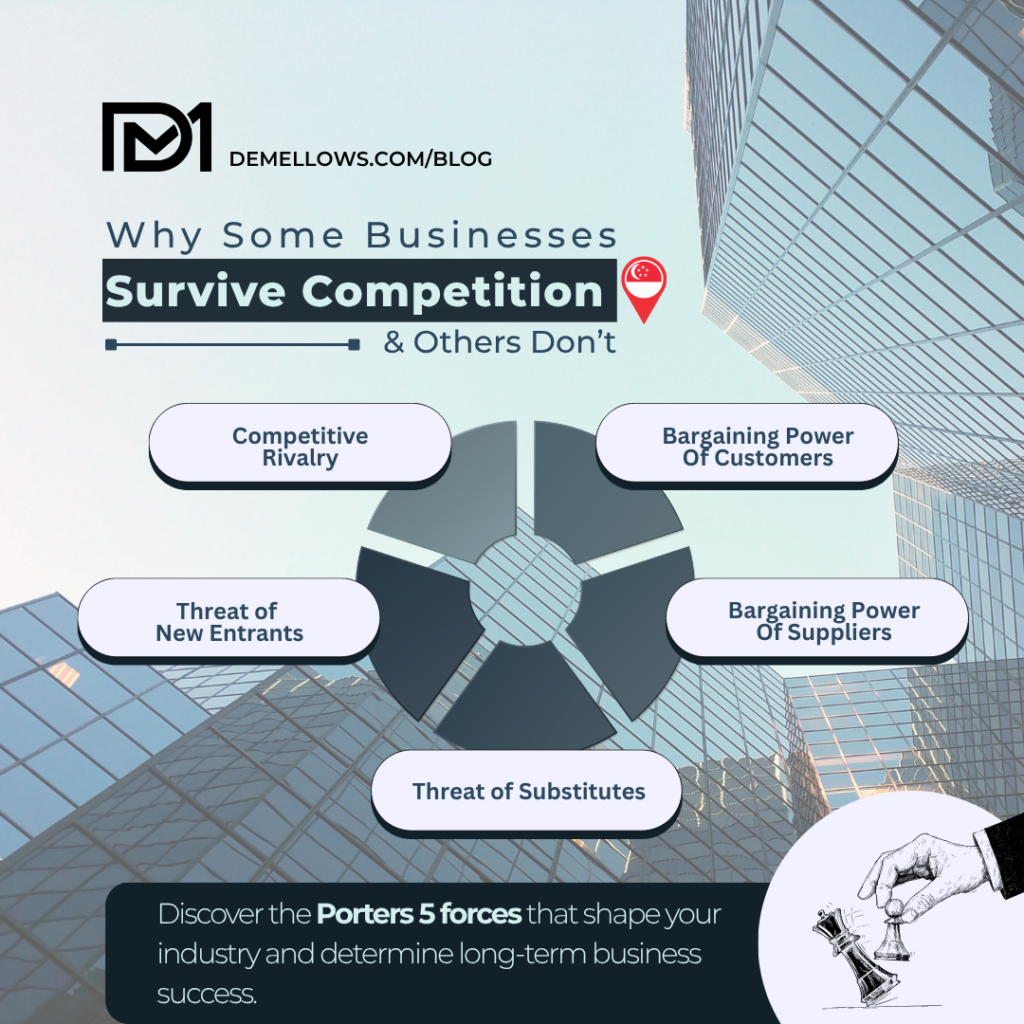
Rather than focusing only on direct competitors, it examines five key forces that influence profitability and long-term success.
The five forces are:
- Competitive Rivalry
- Threat of New Entrants
- Bargaining Power of Suppliers
- Bargaining Power of Customers
- Threat of Substitutes
Together, these forces determine how attractive and profitable an industry can be.
Let’s explore each one in the context of businesses operating in Singapore.
- Competitive Rivalry: How Intense is the Competition?
Competitive rivalry refers to the number and strength of competitors within your industry.

In Singapore, competition can be particularly intense due to the country’s relatively small market size and highly connected consumer base. Businesses often find themselves competing not only with local players but also with international brands.
Example
Consider the café industry. A customer walking through areas such as Tanjong Pagar, Bugis, or Orchard can choose from countless cafés, coffee chains, and specialty coffee shops. With so many options available, businesses must constantly differentiate themselves through quality, customer experience, branding, or unique offerings.
How to Stay Competitive
- Develop a clear unique selling proposition
- Focus on customer experience
- Build strong brand recognition
- Offer products or services that competitors cannot easily replicate
Businesses that fail to differentiate themselves often end up competing purely on price, which can reduce profitability over time.
- Threat of New Entrants: How Easy is it for Others to Enter the Market?
Every successful business attracts attention. If an industry appears profitable, new competitors will naturally want a share of the market.

The easier it is to start a business in an industry, the higher the threat of new entrants.
Example
Online businesses have relatively low barriers to entry. Anyone can launch an online store through platforms such as Shopify, Shopee, or Lazada with minimal upfront investment. As a result, existing businesses face a constant stream of new competitors.
On the other hand, industries such as manufacturing or telecommunications require significant capital, expertise, and regulatory compliance, making it more difficult for new players to enter.
How to Protect Your Position
- Build a strong brand reputation
- Develop customer loyalty
- Invest in specialised expertise
- Create operational efficiencies
The stronger your relationship with customers, the harder it becomes for new entrants to take market share away from you.
- Bargaining Power of Suppliers: How Much Influence Do Suppliers Have?
Suppliers play a critical role in many businesses. When suppliers have significant power, they can increase prices, reduce flexibility, or affect product quality.

Example
A local restaurant may rely on specific suppliers for ingredients. If only a few suppliers offer those ingredients, the restaurant has limited negotiating power and may be forced to accept higher costs.
Similarly, businesses that depend heavily on a single software provider or technology vendor may face challenges if prices increase or service levels change.
How to Reduce Supplier Power
- Diversify your supplier network
- Build strong supplier relationships
- Negotiate long-term agreements
- Explore alternative sources
Businesses that rely too heavily on one supplier can expose themselves to unnecessary risks.
- Bargaining Power of Customers: How Much Choice Do Customers Have?
Today’s customers have more information and options than ever before. With a few clicks, they can compare prices, read reviews, and switch to competitors.

When customers have many alternatives available, their bargaining power increases.
Example
Singapore consumers are highly digital and informed. Before making a purchase, many customers compare prices across multiple platforms, read online reviews, and seek recommendations from social media.
For industries with many similar offerings, customers can easily switch brands if they feel they are not receiving enough value.
How to Reduce Customer Power
- Focus on customer experience
- Build brand loyalty
- Offer unique value propositions
- Create personalised experiences
When customers feel emotionally connected to a brand, they are often less sensitive to price differences and more likely to remain loyal.
- Threat of Substitutes: What Alternatives Exist?
A substitute is not necessarily a direct competitor. Instead, it is an alternative solution that satisfies the same customer need.

Many businesses underestimate this force because they focus solely on direct competitors.
Example
A traditional taxi company does not just compete with other taxi operators. It also competes with ride-hailing services such as Grab, public transportation, car-sharing services, and even cycling options.
Similarly, a gym may compete with home workout apps, online fitness programmes, and wearable fitness technology.
How to Address Substitute Threats
- Continuously innovate
- Understand changing customer needs
- Improve convenience and accessibility
- Deliver a superior customer experience
Businesses that fail to adapt to changing consumer behaviour often lose relevance over time.
Applying Porter’s Five Forces to Your Business
You do not need to be a large corporation to benefit from this framework. Small businesses can apply it by asking a few simple questions:
- Who are my biggest competitors?
- How easy would it be for a new competitor to enter my market?
- Do I depend heavily on specific suppliers?
- How much choice do my customers have?
- What alternatives could replace my product or service?
The answers often reveal opportunities that may otherwise be overlooked.
Conclusion
Competition is not just about who offers the lowest price or the most features. Businesses succeed when they understand the broader forces influencing their industry and respond strategically.
Porter’s Five Forces provides a practical framework for analysing competition, identifying risks, and uncovering opportunities for growth. By examining competitive rivalry, new entrants, supplier power, customer power, and substitutes, businesses can make more informed decisions and strengthen their market position.
In Singapore’s fast-moving and highly competitive business environment, understanding these forces can help businesses not only survive competition but thrive despite it.
💡 Pro Tip: The most successful businesses do not simply react to competition. They understand the forces shaping their market and position themselves strategically before challenges arise.